The Riskiest Thing Your Brand Can Do Is Play It Safe

Why established businesses should be brave enough to look and sound different
For an established business in a crowded market, the safest-looking decision is usually the most dangerous one. Choosing to look and sound like the rest of your category doesn’t remove risk. It swaps a visible risk for an invisible one: the risk of being overlooked, forgotten, and slowly reduced to a name on a list where nobody can tell you apart.
For many leaders, distinctiveness can feel like a gamble. In reality, sameness is the riskiest bet, and most brands are making it without noticing.
That’s what this article is built on, so read on to hear why I think B2B organisations need to be creatively brave during a rebrand, and what you can do about it.
Nobody decides to look like everyone else, but it happens
Sameness in branding is rarely a rational choice; it arrives as a slow accumulation over time.
What often happens is that you watch a competitor’s campaign land well, so you borrow the logic. You hire experienced people from across the sector, and they bring their conventions with them. You take the brand to a new board and someone, meaning well, says it should feel “more credible, more serious.” So the distinctive edges get rounded off in the name of professionalism. Every single decision is defensible. The cumulative result is a brand that looks like a slightly different shade of the same thing.
Rory Sutherland, Vice Chairman of Ogilvy, describes the trap underneath all this rather well.
He argues that organisations are biased towards choices that are easy to justify rather than choices that actually work. A safe, conventional move fails quietly and gets nobody blamed. A distinctive move carries visible risk, so even when it’s the better bet, it feels harder to defend in the room. One of his sharpest provocations is that the opposite of a good idea can also be a good idea. Most categories are full of brands that picked the defensible option and quietly disappeared into the middle of the pack.
So the real question isn’t “is being different risky?” It’s
“who decided being the same was safe?”
You’re sitting on the advantage that disruptors pay years to build
Established businesses regularly underrate themselves. You already own the thing new entrants spend years and fortunes trying to manufacture. Credibility, proof, a track record, long-term relationships that actually mean something – these things are often forgotten and taken for granted by established firms. A disruptor has to build trust from nothing. You’ve already earned it.
And yet so many established brands spend that hard-won advantage looking almost identical to competitors who have far less to lose. It’s the strategic equivalent of holding a winning hand and choosing to play it face down. The instinct to protect what you’ve built is understandable. But hiding a strong position within the conventions of your category doesn’t protect it.
The part everyone competing on logic gets wrong
The assumption buried inside most B2B categories is that buyers choose rationally, that if you line up the features, sharpen the specification and price it keenly, the logic will win. So everyone competes on the same rational ground, with the same rational claims, and the category converges on a single sensible template.
But decisions aren’t made that way, and the people who study how brands actually grow have the evidence to prove it. Differentiation, in the way most businesses mean it, barely registers with buyers. What drives choice is distinctiveness and the feeling attached to it. Professor Byron Sharp and the Ehrenberg-Bass Institute have shown across category after category that buyers don’t hold detailed, reasoned rankings of rival brands in their heads. They reach for whichever brand is most mentally available, the one that comes to mind fastest and feels most familiar when the moment to choose arrives.
This is where the emotional case stops being soft. Google and the CEB Marketing Leadership Council studied thousands of B2B buyers and found that B2B brands, on average, drove far stronger emotional connections than consumer brands, not less!
Their research found B2B buyers were significantly more likely to purchase and to pay a premium when they felt a personal, emotional connection to a brand rather than a purely business one. In a category where everyone is busy competing on logic, the brand that makes people feel something isn’t taking a risk. It’s quietly building the one advantage the spreadsheet can’t replicate.
Because the feeling is the structural advantage. A competitor can copy your feature list by the next quarter. They can match your price by Friday. What they can’t lift is the specific emotional response your brand has built in the mind of a particular person over time. Think of it as ‘logic’ is shared ground, but ‘emotion’ is owned ground. And owned ground is where durable brands are built.
The measurable cost of blending in
For a long time now, the case against ‘sameness’ was made on instinct. That has now changed, and there is evidence to support this.
Strong brands are simply worth more.
Brand Finance, working with the ANA and IAA, found that:
Investors pay meaningfully more for every pound of profit a strong, distinctive brand produces. McKinsey’s research into B2B branding found that businesses with strong-brand ratings delivered EBIT margins around 20% higher than those with weak-brand ratings. Distinctiveness isn’t decoration sitting on top of the business; branding is not colouring in. It shows up in the margin.
Strong-brand ratings delivered EBIT margins around 20% higher
Then there’s the price of being boring, which has finally been quantified.
System1 and Peter Field, drawing on the IPA Databank, found that dull advertising has to spend roughly two to two and a half times more in media to achieve the same commercial effect as advertising that’s actually interesting. Sameness isn’t the economical option. It’s the one you pay for twice – once to make it, and again to drag it into view.
If every campaign you run seems to have to work harder than it should, this is why. Without distinctiveness, there’s no accumulated memory, and no accumulated feeling, doing any of the lifting for you.
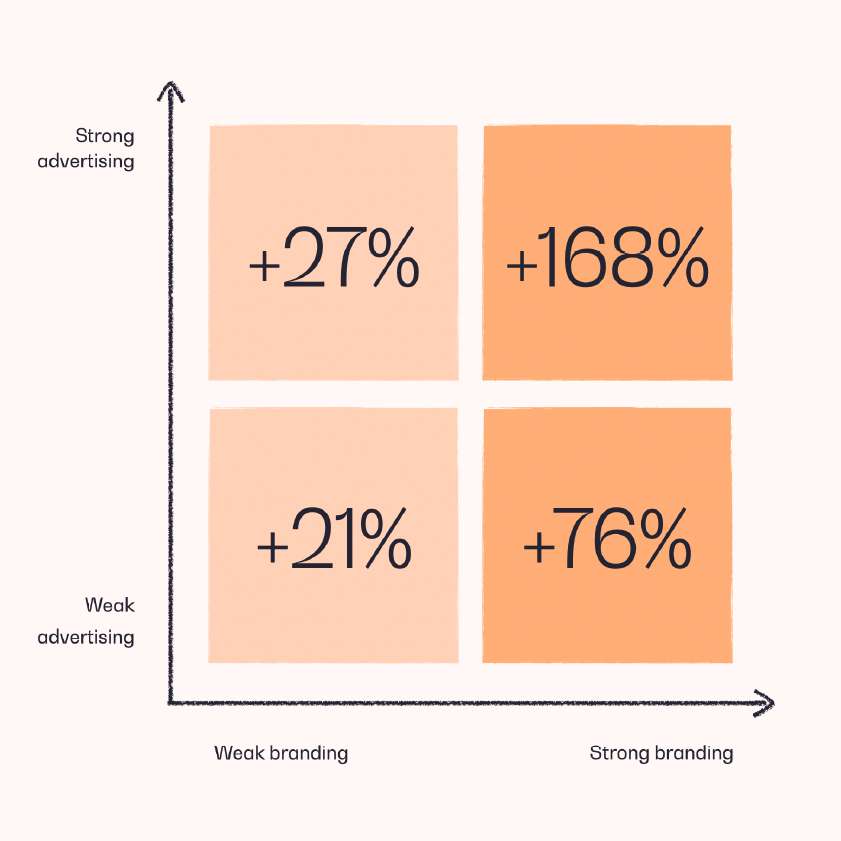
Strong brand and good advertising are incredibly effective in driving value growth.
Marketing Week surveyed 100 brands across a decade.
Distinctiveness is how your brand gets remembered before anyone’s buying
One finding reframes this entire conversation. In most business markets, only around 5% of potential buyers are in the market to buy at any given moment. Professor John Dawes at the Ehrenberg-Bass Institute calls it the 95:5 rule. The overwhelming majority of the people you want as customers aren’t ready to choose today. They’ll be ready in six months, or two years, or whenever their current contract runs out.
So what is your brand actually for? It’s to be remembered by that 95% long before they’re ready to act, so that when the moment finally comes, you’re already the name in their head. You can’t do that if you look and sound like the four brands sitting next to you. Memory needs something to hold onto. A brand that blends in gives it nothing to grip.
This will likely genuinely unsettle any leadership team playing it safe. Distinctiveness isn’t a creative indulgence to be tolerated once the serious work is done. It’s the mechanism by which you get recalled at the only moment that matters. Sameness doesn’t just make you less memorable. It quietly hands that moment to whoever was brave enough to stand out instead.
A new reason this matters
There’s a major shift underway that sharpens all of this further, and it has nothing to do with human attention.
More B2B buyers now start their search with AI tools rather than a search bar. And large language models are, at their core, pattern-matchers. They surface, summarise and recommend what’s coherent, clear and distinct. A brand that sounds like ten others in its category is genuinely harder for a machine to characterise, harder to surface, and harder to recommend with any confidence.
For years, looking like your category was a human engagement problem. Now it’s a structural one too. If an AI can’t tell you apart from your competitors, it can’t put you forward. Distinctiveness has become a discoverability issue, and the brands clinging hardest to convention are the ones most at risk of being filtered out before a human ever sees them.
What brave actually looks like (and what it doesn’t)
Being distinctive doesn’t mean being loud for the sake of it, chasing novelty, or throwing away everything that already works. The goal isn’t noise, it’s clarity that is sharp enough that nobody could mistake you for anyone else.
It tends to start with a harder question than most brands are willing to sit with: who are we actually for, and what do we genuinely mean to them? Not “enterprise decision-makers” as a faceless category, but real people with real pressures, anxieties and ambitions. This is the heart of our Business-to-People (B2P) method. When you’re selling to a business, you’re never really selling to a business. You’re selling to a person who has something to prove, a reputation to protect, and a decision they’ll have to justify to others.
Get that understanding right and distinctiveness stops being something you bolt on. It becomes something you uncover, a truth about your business specific enough that no competitor can lift it, because it’s actually yours.
That’s the line between brave and reckless. Reckless is being different to get noticed. Brave is being clear about who you really are, and refusing to disguise it as something more generic just to feel safe.
The choice in front of you
So back to where we started. The urge to protect what you’ve built makes complete sense. But protecting a position and preserving it are not the same act. You don’t protect a strong brand by tucking it into the conventions of your category. You protect it by making it unmistakable.
The established brands that win the next decade won’t be the ones that played it safe. They’ll be the ones that looked at a category sliding towards sameness and had the nerve to step out of the line. Not louder than everyone else. Just unmistakably themselves.
If keeping things the same has started to feel like the responsible choice, we’d gently ask you to think again. In a crowded market, it’s the riskiest move you can make.
How we can help
Is your brand blending in when it should be standing out?
You can’t fix what you can’t see, and category sameness is notoriously hard to spot from the inside. That’s exactly what the Nalla brand review is for.
In 30 minutes, we’ll give you an honest, expert read on where your brand is genuinely distinctive, where it’s moving towards the category average, and where the real opportunity to stand out is hiding.
No jargon. No sales pitch. Just clarity on whether your brand is working as hard as it should be.
Book this in today and find out where you stand out, and where you’re disappearing into the crowd.

FAQ
What are the risks of looking like everyone else?
We’ve gathered the most common questions people ask about this topic and answered them clearly and simply below. Hopefully you’ll find exactly what you’re looking for.
Is it really riskier to look like everyone else than to stand out?
In a crowded market, yes. Looking like your category feels safe because it attracts no obvious criticism. But it carries a hidden cost: you become hard to remember, hard to choose, and hard to tell apart from cheaper rivals. The risk doesn’t show up as a dramatic failure. It shows up as slow erosion, longer sales cycles, weaker pricing power and campaigns that have to work harder every time. Standing out carries visible risk. Blending in carries invisible risk, which is usually the more expensive of the two.
Why do established businesses end up looking like their competitors?
Almost never on purpose. It happens through a series of individually reasonable decisions: benchmarking against a rival’s campaign, hiring people who bring sector conventions with them, smoothing off distinctive edges to seem more credible. Meanwhile every new entrant is doing the same thing, so the whole category drifts towards a single template. Nobody makes one obviously wrong call. Everyone just inches towards the middle until customers genuinely can’t tell the difference.
Is brand differentiation rational or emotional?
Largely emotional, and that’s the part most B2B categories underestimate. Research from the Ehrenberg-Bass Institute shows buyers rarely hold detailed, reasoned rankings of rival brands. They choose whatever is most mentally available and feels most familiar. Work by Google and the CEB Marketing Leadership Council found B2B buyers were more likely to buy, and to pay a premium, when they felt a personal, emotional connection to a brand. In a category competing on logic, being the brand that makes people feel something is a structural advantage, because feeling is the one thing a competitor can’t copy from your specification sheet.
Does brand distinctiveness actually affect commercial performance?
The evidence says clearly yes. Brand Finance, with the ANA and IAA, found companies with stronger branded businesses command a 65% premium in forward price-to-earnings ratios. McKinsey found strong B2B brands delivered EBIT margins around 20% higher than weak ones. System1 and Peter Field found dull advertising has to spend roughly two to two and a half times more to achieve the same effect as interesting advertising. Distinctiveness isn’t a cost centre. It shows up in margin, in media efficiency and in valuation.
What is the 95:5 rule and why does it matter for rebranding?
It’s a finding from Professor John Dawes at the Ehrenberg-Bass Institute: in most business markets, only around 5% of potential buyers are in the market at any given moment. The other 95% will buy later. The job of a distinctive brand is to be remembered by that 95% long before they’re ready, so you’re already the name they think of when the moment arrives. A brand that looks like everyone else gives that memory nothing to hold onto, and hands the moment to a competitor who stood out.
How does brand distinctiveness affect AI search and discovery?
AI tools, including large language models, are pattern-matchers. They surface and recommend brands that are coherent, clear and distinct. A brand that sounds like ten others in its category is harder for these systems to characterise accurately, harder to surface, and harder to recommend with confidence. As AI-driven discovery becomes a bigger part of how buyers find suppliers, distinctiveness stops being only a human engagement challenge and becomes a structural advantage in whether you’re found at all.
What does genuine distinctiveness look like in practice?
Not a bold colour or a clever tagline on their own. Those are surface expressions of something deeper. Real distinctiveness starts with knowing precisely who you’re for and what you mean to them, then building everything around that truth. It’s rooted in the real character of the business and the real needs of its people, which is exactly why a competitor can’t lift it. They can approximate your visuals. They can’t copy the emotional truth underneath.
Other insights by Vicki
About Vicki Young
Vicki Young (she/her) is Founder and CCO of Nalla. After working for two of the most respected creative agencies within the industry, she set up Nalla as a tribute to her late father, Allan.
A thought-leader in the branding space, Vicki’s insights are regularly featured in publications such as The Times, Creative Review and Transform Magazine.
Related content
How to talk to the next generation without losing everyone else
Should You Choose the Award-Winning Agency or the One That Can Show You Results?
How a Professional Services Firm Can Regain Relevance
How to avoid sounding like every other company in your industry