How to avoid sounding like every other company in your industry
Long Read
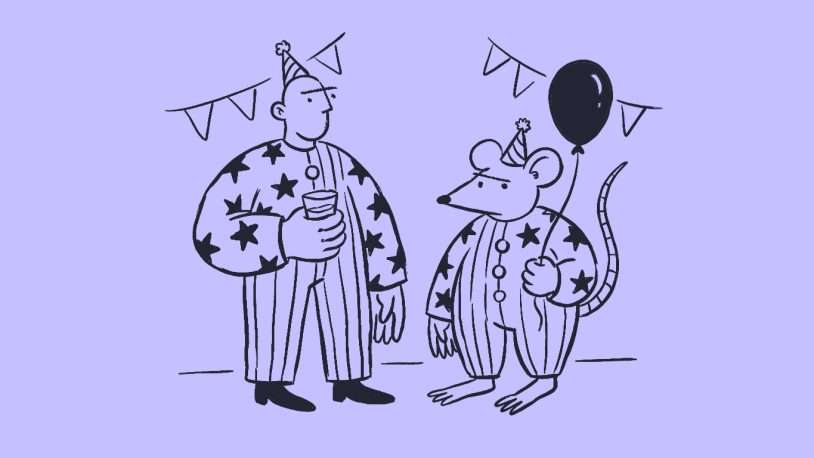

Have you ever walked into a party and realised you’re wearing the exact same outfit as someone else? That’s your brand right now.
Sounds harsh, but if you’re reading this, there’s a good chance you’ve had that nagging feeling for a while. You’ve looked at your website, then your competitor’s website, then another competitor’s website… and you start to wonder if you’ve all been using the same strategists, copywriters and designers!
Is your brand’s positioning identical to your competitors’?
Last week in the studio, while working on a brief, we took the homepage content from three competing SaaS brands in the financial space, removed all colour and shuffled the brand names. We then sent this to a few friends of mine who work in financial services and asked them to match the homepage content to the brand.
They all got it wrong; they couldn’t do it.
These are people who are in the sector and whose job it is to follow who is doing what; they are aware of these brands. Yet they still couldn’t tell them apart.
Now, you might be thinking this is just a fintech problem, but it’s not. Try it with management consultancies, niche SaaS platforms, or even our fellow branding agencies. The language is interchangeable, and often the promises are identical. Everyone’s “customer-centric” and “driving transformation” and therefore it feels that nobody is.
The cost of this invisibility isn’t just about losing sales to competitors, though that stings enough. It’s what happens to your team (those in the front line) when they can’t articulate why your business is different to others. It’s the otherwise brilliant people you don’t hire because they can’t see what makes you different. It’s the investors who pass because they’ve heard this pitch perhaps seventeen times before.
How do I avoid sounding like every other company in my industry?
There’s this thing that happens in many organisations, and we are all guilty of it. We look at our competitors and get really caught up in trying to copy it or use it as a benchmark and match it.
Playing it safe feels professional and might feel right for your B2B market – it’s what you do when you want to be taken seriously, but there’s a problem with looking inward at your sector: everyone follows everyone else. There becomes a baseline language of what everyone’s already doing while pretending it’s special. Rory Sutherland (advertising heavyweight and Vice Chairman at Ogilvy) said something interesting recently,
“Most businesses focus on what the competitors are doing well at and then try to copy it. But you can find an edge when you flip it. Instead of focusing on what they do well, focus on what they’re weirdly really bad at – that’s where the innovation lies.”
While this shift in perspective is powerful, there’s also real value in looking beyond your category altogether. Interesting things happen when ideas fuse. Take Domino’s, for example. The global pizza giant didn’t build its brand on swirly typefaces and Italian flags. Instead, it drew inspiration from delivery services for goods and Taxi firms. They flipped the script to focus on speed and convenience over traditional cues of pizza quality.
What’s actually happening is that many brands have forgotten they’re talking to people. Real humans with inbox anxiety and too many browser tabs open. Instead, they’re writing for some imagined corporate audience with plenty of time on their hands.
Those real people need “sticky ideas”, something that aids recall and ensures your brand is not blending in. But it’s also key to not be radically different for difference’s sake – you need to stand out by being different in a way that is right for your audience.
This is where B2P thinking comes in. Business to People, not B2B or B2C. It sounds simple, almost obvious, but it changes everything.
What makes brands stand out?
Differentiation is not some clever positioning statement crafted in a boardroom, but a genuine understanding of the humans you’re trying to serve and what actually matters to them on a Friday afternoon when they’re tired and need something to work properly!
This is where most brands get it wrong. They think differentiation is only about being different from competitors. It’s not; it’s about being unmistakably yourself while speaking to people like people and being brave enough to not follow the pack.
When we work with clients at Nalla, this is sometimes where the conversation gets uncomfortable. Because being clear about who you’re for means accepting that some people won’t choose you. Some people won’t like you, and some will actively prefer your competitor. That’s terrifying for most organisations, and as a business owner myself I really get that.
We want to be liked; we want everyone to think we’re great. So, we smooth off the edges, make sure nobody could possibly be offended or put off or even mildly inconvenienced by what we’re saying (us Brits are the worst for this!)
The problem is, when you try to be for everyone, you end up being for no one in particular. You become the brand equivalent of that person at a dinner party who agrees with everyone and never has an opinion on anything. Perfectly pleasant but alas completely forgettable – vanilla.
How to ensure you don’t look and sound like your competitors
There’s a question we sometimes ask clients that tends to open a conversation; it’s weirdly surprisingly hard to answer honestly.
“What would you do if your competitors didn’t exist?”
Not “what would you do differently”. But what would you do if you weren’t constantly looking over your shoulder at what everyone else is doing?
Most brands accidentally build for the competition, not for the people they’re trying to reach. They see a competitor launch a feature, so they rush to launch something similar. They read a competitor’s positioning, so they tweak theirs to be just slightly different. They’re playing a game of competitive one-upmanship that nobody outside the organisation cares about.
So, what if you ignored the competition entirely and focused on what the people you’re trying to serve actually need? Try spending a month talking to your customers. Not only about features – include what your customers working day looks like and where the friction is.
Perhaps it turns out that your customers don’t care about half the features you’ve been building. Maybe you’ll hear that what they wanted was something simpler, faster and less cluttered without the extra features that they would never use. Think of the modern car, overloaded with features that most drivers never use. Or maybe they even want things you hadn’t considered – that’s where the differentiation can be found.
That’s the B2P impact – designing for people, not for personas on a slide deck. Not for target segments in a strategy document. Not for “the market” but for actual humans who are trying to get something done without wanting to put their fist through their laptop!
What this Means
How can a branding agency help you differentiate?
You probably already know what makes your brand different. It’s there, somewhere, buried under layers of corporate language and attempts to be professional. When you work within a business, you’re often so close to the product that you offer and are almost blinded by the narrative that went before, it’s hard to see the wood for the trees. An agency can help you uncover and spot what makes your business different. When we kick off a project with clients internally at Nalla, we call this looking for the hidden gems!
Your unique positioning is hidden in the conversations you have – often when nobody’s checking your work. It’s in the reasons people choose you over competitors, not the reasons you think they should. It’s in the things your team gets excited about when they’re not reading from the strategy document.
At Nalla, we’ve built our entire approach around this idea. The B2P approach isn’t just about writing friendlier copy or using fewer buzzwords. It’s about fundamentally thinking who you’re building for and recognising that behind every business decision is a real person.
When you design for that person instead of for “the market”, things change. You stop sounding like everyone else because you’re no longer trying to. You start making choices that might feel risky but are just honest. You build something that matters to specific people instead of something that’s fine for everyone.
The hard part isn’t finding what makes you distinctive. The hard part is having the courage to be distinctive. To talk like a human, stop playing it safe and start being memorable.
That’s how brands stand out. Not by being louder or more clever or more polished. By being unmistakably themselves, for specific people, in language that sounds like it came from someone who gets them and their business.
FAQs
Common questions people ask around this topic
We’ve gathered the most common questions people ask about this topic and answered them clearly and simply below. Hopefully you’ll find exactly what you’re looking for.
What if my product isn’t that different, how can my brand stand out anyway?
If your product isn’t radically different, your brand has to do the heavy lifting. Standing out is about understanding your customers more deeply than anyone else and articulating that clearly. Spend real time with customers, uncover what genuinely matters to them both rationally and emotionally and build a narrative around that truth. The difference is rarely in the product; it’s in the perspective. Be clear in your brief to a specialist agency that distinctiveness matters, but more importantly, be brave enough to express what makes you meaningfully different that needs to be visually and strategically.
Should we focus on features or benefits?
Most companies are rightly obsessed by the features of their product or service, but few are good at communicating why their audience should actually care about those features. As customers, we’re rarely interested in the size of the memory, the units of energy saved, the new dashboard, the upgraded performance. What interests us is how those features will benefit our lives. And the more these benefits tap into our emotions, the better. Whether we recognise it or not, we can’t help but make decisions based on emotion. Your brand shouldn’t tell me what it can do, it should tell me what it can do for me. Research consistently shows that our decisions are driven by the heart and not the head, even if we don’t recognise it. And when we make emotion-based decisions we’re willing to pay more, we’ll be more loyal and ultimately feel more invested.
How do I avoid sounding like every other company in my industry?
Start by benchmarking your brand against your competitors; then use this as a springboard to define and develop your own points of difference. Look for what the competition isn’t doing well; that can give you an interesting pivot point too. Whether it’s finance, AI, professional services, training, or legal, choosing to adopt the sector’s branding conventions shows a lack of originality, direction, and opinion, which leads to sounding like everyone else. Ask what you can learn from your audience. Which brands and organisations do they find engaging, inspiring or even exciting? What do they really want from us and what fustrates them.
Standing out is just one step in building brands that people choose. Order our book to learn the complete B2P approach for creating brands that people remember, recommend, and refuse to replace.
Other insights by Vicki
About Vicki Young
Vicki Young (she/her) is Founder and CCO of Nalla. After working for two of the most respected creative agencies within the industry, she set up Nalla as a tribute to her late father, Allan.
A thought-leader in the branding space, Vicki’s insights are regularly featured in publications such as The Times, Creative Review and Transform Magazine.
Related content

The Riskiest Thing Your Brand Can Do Is Play It Safe
Should You Choose the Award-Winning Agency or the One That Can Show You Results?
How a Professional Services Firm Can Regain Relevance

Is your brand talking to people or at them?